
As Australia’s battery fleet rapidly expands, charge curtailment is starting to become a more pronounced challenge for the technology.
Charge curtailment occurs when a line overloads, and a charging battery is curtailed as opposed to a discharging generator.
Batteries with negative constraint coefficients are at risk of being charge curtailed.
KESSB1 was the number one charge curtailed battery in FY25/26, pushing its charging out of periods averaging -$2.02/MWh and into periods averaging $22.46/MWh.
With a large pipeline of batteries heading toward connection, charge curtailment is set to become a standard part of battery operations and a key consideration for project revenue.
Introduction
With Australia's battery fleet rapidly expanding, storage is becoming a central part of the future technology mix. At the same time, charge curtailment is emerging as a key operational challenge that limits a battery's ability to access low priced energy and capture the commercial value it was designed to deliver. As more projects connect to parts of the grid already experiencing congestion, understanding how charge curtailment works and why it matters is becoming essential to strengthening the commercial potential of storage in the NEM.
Understanding charge curtailment
Curtailment is a familiar challenge. When generators discharge into the grid, their power flows across transmission lines towards loads. Each line has a safe operating limit, and when that limit is reached, AEMO reduces the output of the generators contributing to the flow to prevent an overload. This is a commonly understood form of curtailment: generators are scaled back because their discharge pushes too much power down a constrained part of the network.
The same principle applies when a battery is charging. A charging battery draws power from upstream generation, pulling power down the line rather than pushing it up the line. With the increased power flow that can occur during charging, there is a risk of exceeding the line's limit. Hence, AEMO will curtail the unit that is contributing most to the overload. When the unit being reduced is a battery during charge, this is referred to as charge curtailment.
Charge curtailment in the NEM
As storage investment accelerates nationwide, several batteries in the NEM are beginning to experience charge curtailment. Koorangie BESS (KESSB1), located in North West Victoria, is one example of a project currently facing this challenge, with the highest recorded levels of charge curtailment in FY25/26.
KESSB1 sits within an area referred to as the Rhombus of Regret, a part of the network that has long been associated with sustained curtailment driven by the voltage stability constraint, V^^V_NIL_KGTS. Years after solar farms in the region first encountered this constraint, KESSB1 is now experiencing charge curtailment from the same voltage stability mechanism that gave the area its reputation.
V^^V_NIL_KGTS exists because the grid struggles to support voltage over long distances, especially when transmission lines are heavily loaded. To manage voltage fluctuations in North West Victoria, V^^V_NIL_KGTS manages loading along Wemen to Koorangie on trip of Horsham to Murra Warra to Kiamal.
To decide which units are curtailed, AEMO assigns every unit a "factor" that describes how much and in which direction the unit contributes to the line's flow. More importantly, the factor determines the order in which units are curtailed when the constraint binds. The highest positive factor in V^^V_NIL_KGTS belongs to Bannerton and Wemen solar farms, since their discharge pushes power down the line towards Koorangie. If you scroll down in the factor list below you can see the highest negative factor belongs to KESSB1, since its discharge output pushes power in the opposite direction, helping to relieve the constraint.
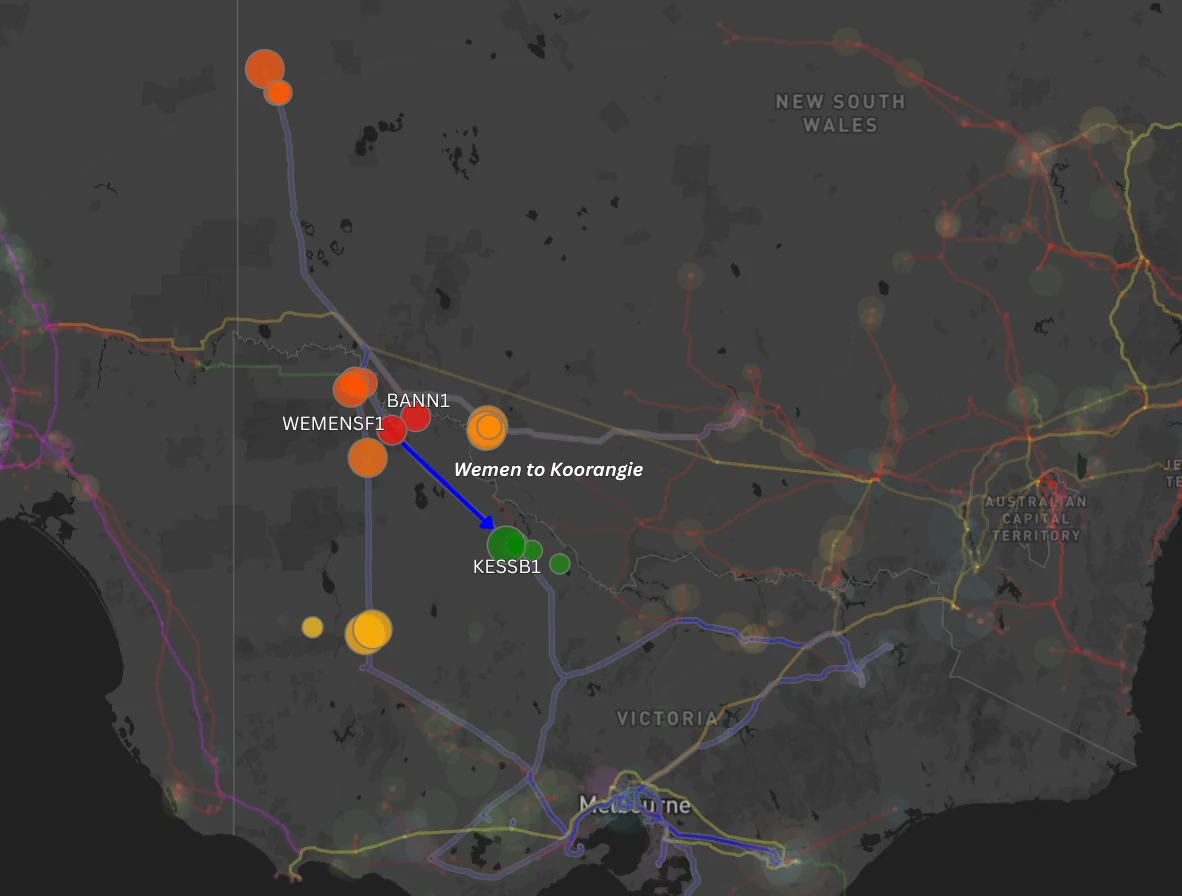
However, when KESSB1 is charging it pulls power toward itself from Wemen to Koorangie, increasing the line loading and making congestion worse. Since charging is effectively "negative output", the sign of the factor is flipped. In this case, KESSB1's factor is flipped from -1 to +1.
Now having the highest factor of all the units in the constraint, KESSB1's charging is the first thing to be curtailed (all else equal), and only after that do we see curtailment for Bannerton and Wemen solar farms.
Why charge curtailment matters
This reversal can have real commercial consequences for operators as the value in charging a battery comes from accessing energy at its lowest price. The unfavourable outcome is being unable to charge at the market's lowest priced periods and, instead, being pushed into more expensive ones.
For KESSB1, V^^V_NIL_KGTS binds most frequently when solar dispatch across North West Victoria is at its highest, which is commonly in summer months around midday. These are often the same periods in which Victorian prices are lowest and, in some cases, negative.
In effect, the conditions that create the best charging opportunities are the same conditions that can cause charge curtailment.
This does not mean KESSB1 is unable to charge at all. Rather it has to move its charging to other periods where the constraint isn't binding as severely (so it can more easily bid around the constraint), or not at all. This often shifts its captured charge price from the lowest priced periods of the day into the second or third lowest, and so on.
As an example, over FY25/26, KESSB1 had its charging curtailed during periods averaging -$2.02/MWh and was instead pushed into charging at higher-priced periods averaging $22.46/MWh. This moved 28.7 GWh away from the cheapest periods available to it. Discharge was affected on a smaller scale, with 5.7 GWh curtailed during intervals averaging $200.13/MWh, instead capturing $127.94/MWh on average.
These effects show how both charge and discharge curtailment can materially impact a battery's captured price spread and ultimately, revenue.
Outlier or emerging trend?
This finding raises an important question for the market: is KESSB1's curtailment an outlier, or an early indication of an emerging trend?
KESSB1 is best understood as an early signal, since most batteries moving forward are likely to experience some degree of both charge and discharge curtailment. With a substantial pipeline of new BESS projects advancing toward connection, curtailment pressures on both the charge and discharge side of operations are expected to rise. This experience mirrors the early expansion of large scale solar, where rapid growth in a single technology created competition for hosting capacity and, in due course, network congestion.
At the end of the day, a battery's revenue is modelled on the spreads it can capture, but it is the network that decides how much of those spreads it gets to keep. Understanding this concept before a project is built may prove to be one of the most valuable steps in its development.
¹ All data sourced from GridScout. Figures reflect historical performance and are subject to change. Past curtailment patterns and revenue outcomes may not be indicative of future results.